
Library overview
Go to Library → Dashboard.
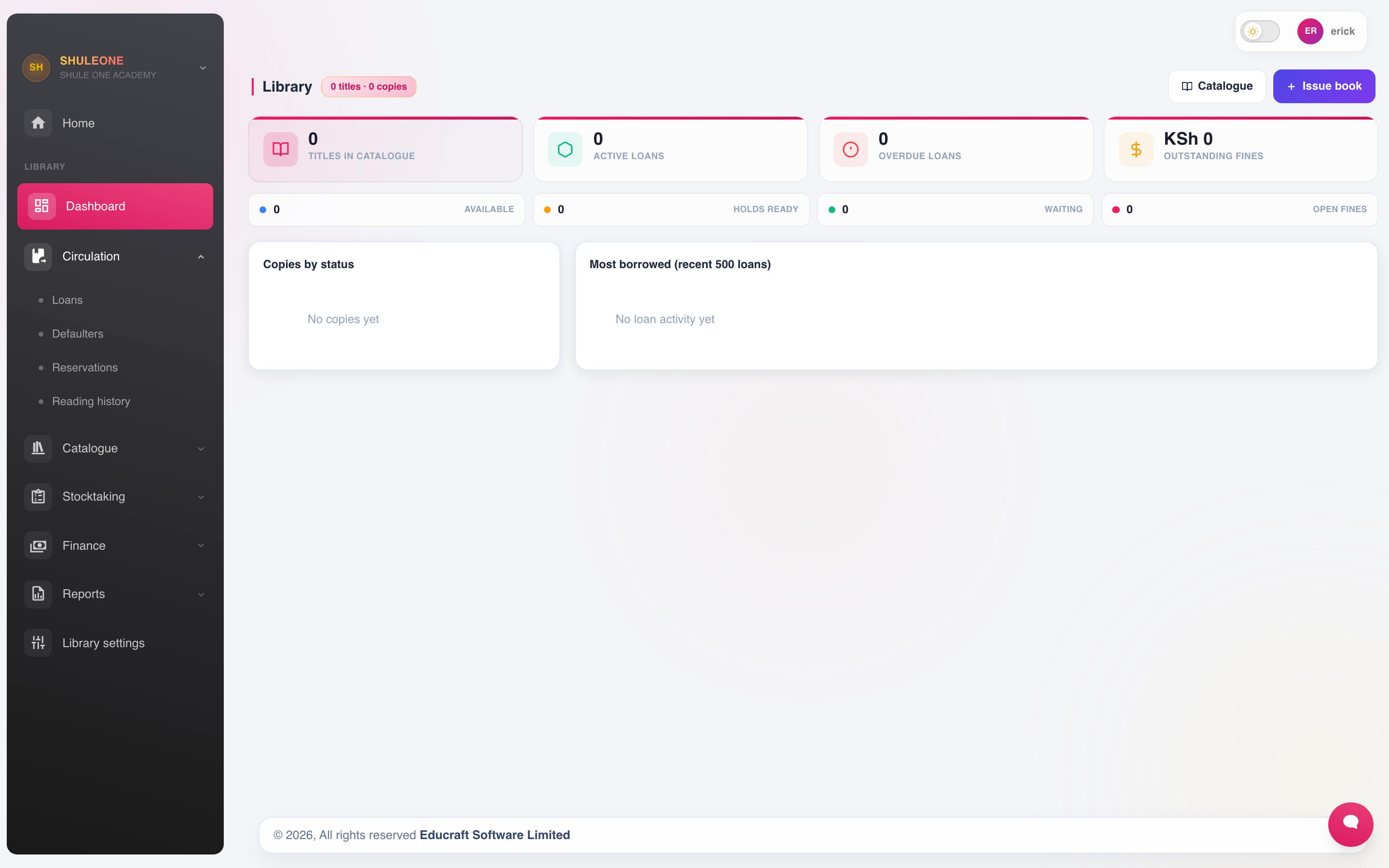
The dashboard summarises the collection, loans, overdue items and unpaid fines.
The dashboard is the librarian’s working screen: what is out, what is late, what is waiting to be collected.
The screens
Section titled “The screens”| Screen | Purpose |
|---|---|
| Books | The catalogue |
| Periodicals | Newspapers, magazines, journals |
| E-resources | Digital material |
| Genres | Classification |
| Loans | Issue and return |
| Reservations | Holds on borrowed items |
| Reading History | What a borrower has read |
| Defaulters | Overdue borrowers |
| Fines | Charges and payment |
| Reversals | Correcting a mistaken transaction |
| Inventory | Stock-take of the collection |
| Reports | Circulation and collection reports |
| Settings | Loan periods, limits, fine rates |
Setting up
Section titled “Setting up”Before the first loan:
- Genres — how the collection is classified.
- Settings — loan periods, borrowing limits and fine rates, per borrower type.
- The catalogue — the books themselves.
Settings worth thinking about
Section titled “Settings worth thinking about”Loan period. Different by borrower type and by material — a student might get 14 days on a general book, a teacher a term on a reference text, and a reserved textbook overnight.
Borrowing limit. The number of items a borrower may hold at once. Without one, one enthusiastic reader empties a shelf.
Fine rate. Per day overdue, usually with a cap. Set the cap deliberately: an uncapped fine on a book lost in Form 1 reaches an absurd figure by Form 4, and the school then waives it, which teaches everyone that fines are not real.
Borrowers
Section titled “Borrowers”Borrowers are students and staff already registered in ShuleOne — the library does not keep its own list. A student admitted in Registration can borrow immediately, and a student who leaves stops being able to.
Which is why a leaver should be checked for outstanding books before their record is closed.