
Results and reports
Academics shows how your child is doing: results by exam and subject, the report card, and the trend over time.
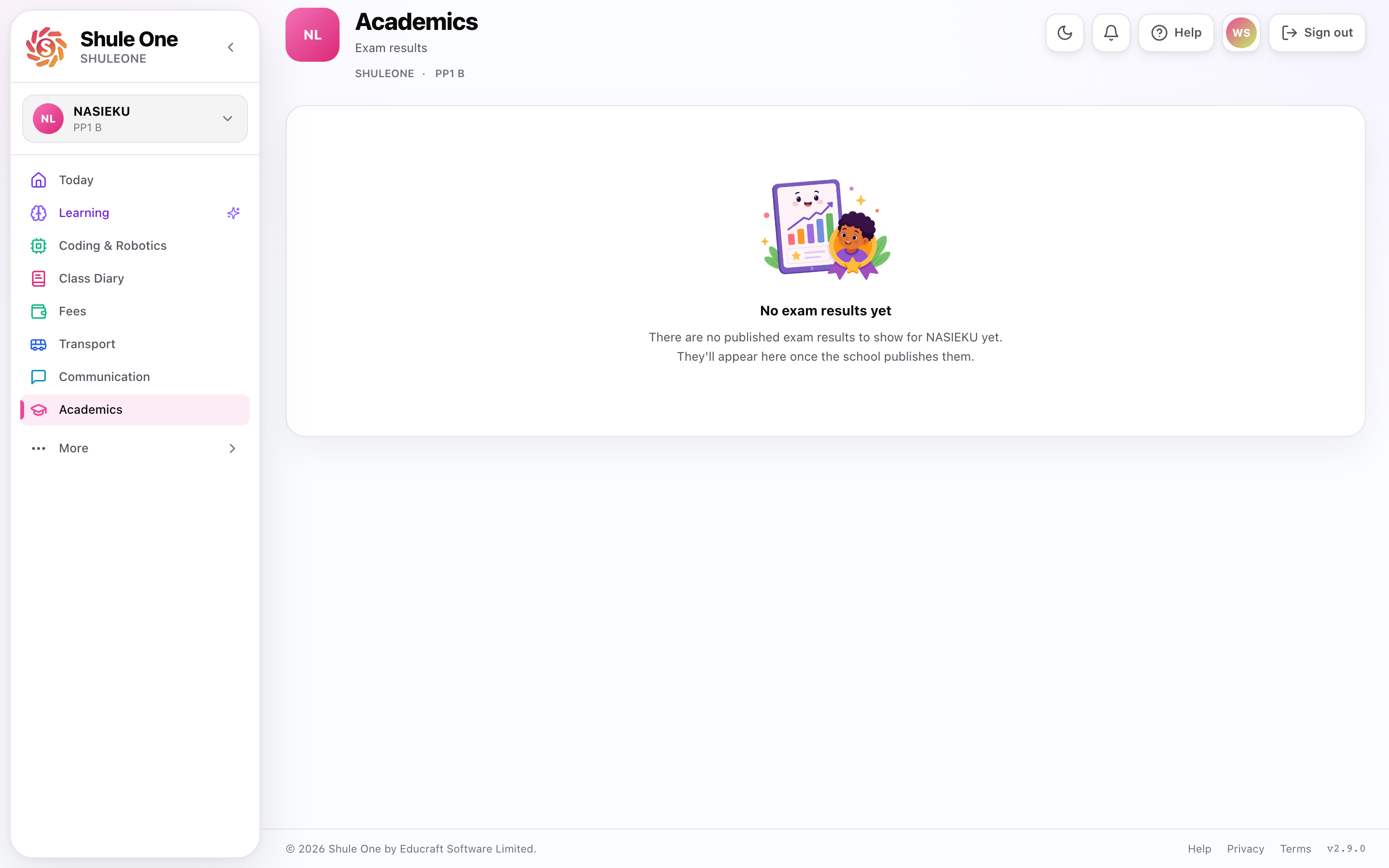
Results appear here after the school releases an exam; this capture has none yet.
Results
Section titled “Results”Results appear once the school releases them. Marks are entered by teachers, checked, and published deliberately — so a gap between an exam and its results is normal and does not mean anything has gone wrong.
For each exam you see the mark and grade per subject, the total and mean, and, depending on the school’s settings, the position in class.
Exam readiness
Section titled “Exam readiness”For a Grade 6 child the readiness card is labelled KPSEA readiness; for Grade 9 it is labelled KJSEA readiness. It starts with the three weakest subjects so the next area to support is clear. Choose Show all subjects to inspect every subject included in the overall value.
Each subject shows a score from 0% to 100%, its trend, and how many valid graded results support it. Where available, the evidence line separates school results from ShuleOne practice-paper results. The overall percentage uses every included subject, not only the three initially visible rows.
If the card says Overall score unavailable, it has not converted missing evidence into zero. Results with missing or invalid marks are excluded, and a subject needs at least two valid graded results before it contributes. Wait for more marked work or ask the school to check an unexpected missing mark.
Report cards
Section titled “Report cards”The report card is the formal document at the end of a term. It carries the marks, the grades, the class teacher’s comment and the head’s comment.
Download it from Documents and keep it. Schools are asked for old report cards more often than you would expect — for transfers, bursaries and admissions — and having your own copy saves a trip.
Reading results usefully
Section titled “Reading results usefully”Look at the subject pattern, not the total. A mean of 62 made of four strong subjects and one very weak one needs a different response from a flat 62 across the board.
Look at the trend. One exam is noise; three in a row going the same way is a signal. The trend graph is the most useful thing on this screen.
Read the comments. Teachers write them to be read. They usually name the specific thing — not finishing work, not asking when stuck, arriving late — that the marks alone do not show.
Be careful with position. Position in a class of 40 moves for reasons that have nothing to do with your child. The mark and the trend say more.
Competency-based reporting
Section titled “Competency-based reporting”Under CBC, subjects are also reported against competencies and performance levels rather than only a percentage.
These describe what your child can actually do. A level against “communicates ideas clearly in writing” tells you more about what to work on at home than a mark out of 100.
What to do about a bad result
Section titled “What to do about a bad result”Do not lead with it. A parent view that turns into an interrogation every time an exam is released stops being useful, because your child learns to dread the conversation.
Ask what happened, and listen. Sometimes it is a topic missed while absent, sometimes it is a teacher change, sometimes it is that they did not revise.
Check attendance for the weeks before the exam. Missed lessons show up in results a month later.
Check what they have been working through in the portal. It shows which topics they were getting wrong before the exam did.
Talk to the class teacher. Use the school’s messaging or ring. Teachers would much rather have the conversation in week 3 than at the end of term.
If a result looks wrong
Section titled “If a result looks wrong”Contact the school. Marks are entered by hand, and mistakes happen — a transposed figure, a mark against the wrong student.
Say which exam, which subject and what you expected. The school can check the entry against the script.